Most UAE small businesses are running their entire operation behind the router their internet provider left on the wall. It routes traffic; it does not defend it. The difference becomes obvious the first time an employee clicks the wrong link, a supplier’s account is spoofed, or someone finds your CCTV NVR exposed to the internet.
What a real firewall does
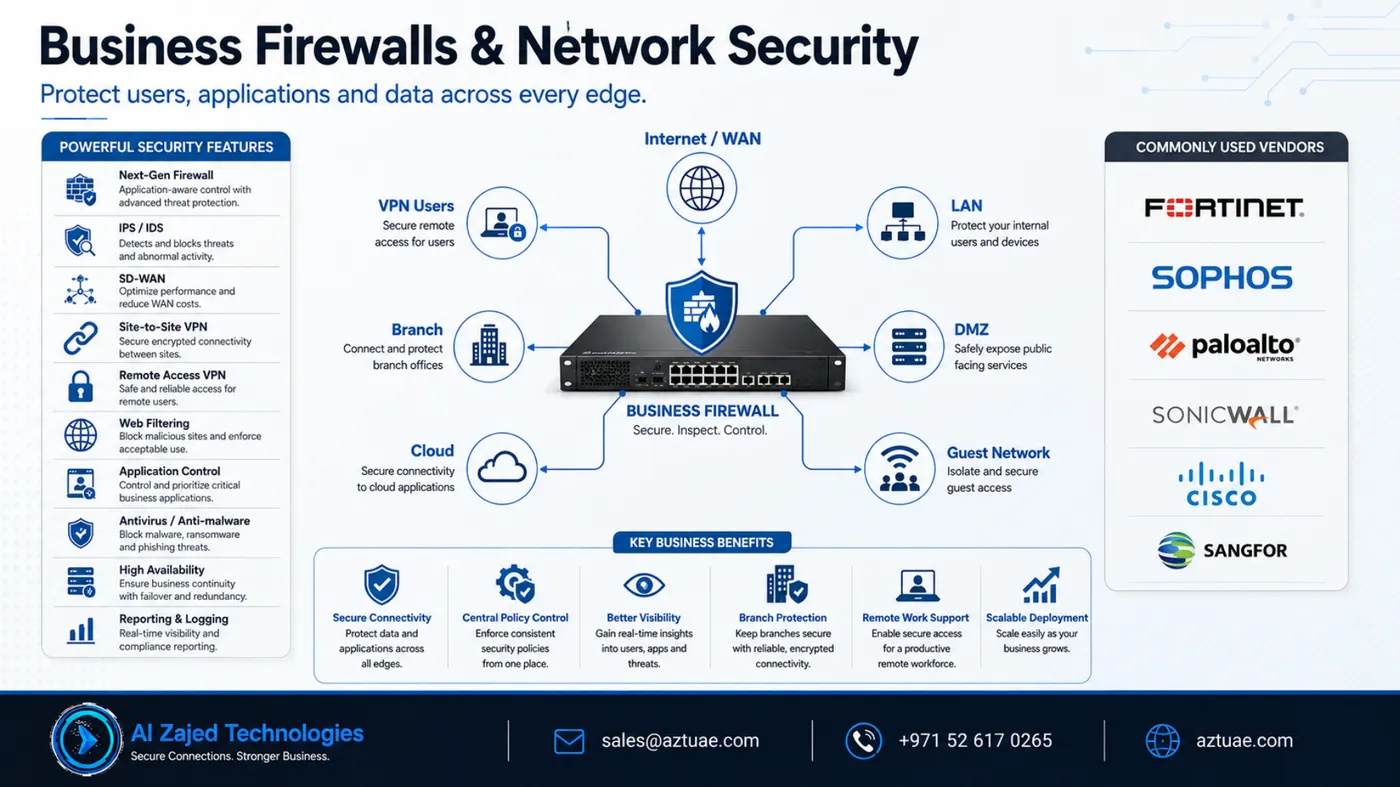
- VPN for remote users — staff and site-to-site branch connections encrypted end to end, instead of exposed remote desktop ports.
- DMZ segmentation — anything that must face the internet (a web server, a booking system) lives in a quarantined zone that cannot reach your LAN.
- Web filtering — malicious and time-wasting categories blocked at the edge, before they reach a single laptop.
- Intrusion prevention — known attack patterns dropped automatically, with logs you can actually audit.
- Guest network isolation — visitors get internet, never your file server.
The UAE angle
Two local realities raise the stakes. First, UAE businesses are heavily WhatsApp- and email-driven, which is exactly where credential phishing lives. Second, many premises run CCTV and access control on the same flat network as accounting — meaning one compromised camera can become a bridge to everything. Segmentation is not an enterprise luxury; it is ten minutes of configuration on a proper firewall.
Sizing without overspending
A 10-person office does not need a datacenter appliance. Right-sizing means matching throughput to your internet line, counting VPN users honestly, and buying licences for the features you will actually switch on. That is exactly what a free network assessment settles before any quotation.